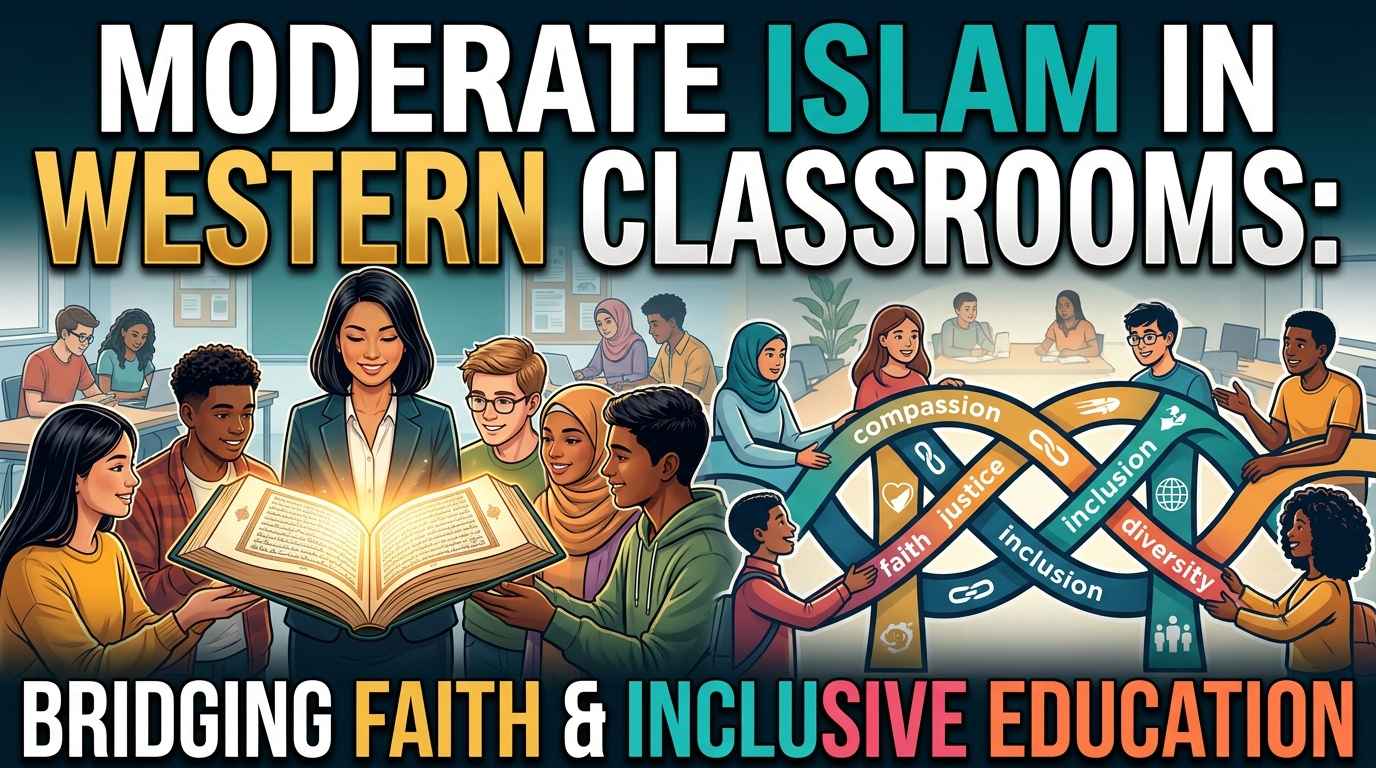
Western educational institutions are increasingly becoming spaces where students from diverse religious, cultural, and ethnic backgrounds encounter one another. Global migration, technological connectivity, and multicultural societies have transformed classrooms into environments where differences in identity, belief, and worldview are part of everyday educational experiences.
Within this context, the role of Islamic education in Western classrooms deserves thoughtful consideration. Islam is frequently discussed through the lenses of security, integration, or cultural difference, while its intellectual, ethical, and educational contributions receive comparatively less attention. Such approaches can limit opportunities for meaningful dialogue and reinforce simplified perceptions of Muslim communities.
The concept of moderate Islam, understood in this discussion as an approach emphasizing balance, compassion, justice, peaceful coexistence, and openness to constructive dialogue, offers a framework for exploring the relationship between faith and inclusive education. However, it is important to recognize that Muslims hold diverse theological and educational perspectives, and no single interpretation represents the entire Muslim community.
Integrating Islamic ethical values into inclusive education should not create new divisions. Instead, it should contribute to classrooms where religious identity and universal human dignity can coexist.
Islamic Values and the Foundations of Inclusive Education
Education is not merely a process of transferring knowledge. It is also a means of developing character, social responsibility, critical thinking, and respect for others. In this regard, Islamic educational traditions offer ethical principles that can contribute to broader discussions about inclusive education.
One important principle is ta’aruf, derived from the Qur’anic teaching in Surah Al-Hujurat, verse 13. The verse emphasizes human diversity and encourages people to know and understand one another. Diversity, from this perspective, can be approached as an opportunity for mutual recognition rather than a justification for prejudice or exclusion.
When applied to Western classrooms, ta’aruf provides a useful foundation for intercultural learning. Students should be encouraged to explore different religious and cultural traditions through respectful dialogue, academic inquiry, and personal interaction.
Such an approach does not require students to abandon their own beliefs. Rather, it encourages them to develop the ability to understand perspectives different from their own while maintaining intellectual independence and ethical responsibility.
Inclusive education, therefore, should not be measured only by the presence of students from different backgrounds. It should also be evaluated by whether those students experience respect, meaningful participation, and equitable opportunities to learn.
Moving Beyond Stereotypes of Islam
Public discussions about Islam in Western societies have sometimes been shaped by security concerns, political conflict, and negative media representations. Although these issues form part of contemporary public discourse, they do not adequately represent the full range of Islamic intellectual traditions or the everyday experiences of Muslim communities.
Classrooms provide an opportunity to examine these complexities through education rather than assumption.
Teaching about Islam should include its contributions to philosophy, science, medicine, literature, ethics, and educational thought. Students can explore the historical development of Islamic civilization while also examining contemporary Muslim experiences and internal diversity.
This approach should avoid both negative stereotyping and uncritical idealization. Academic education requires the ability to discuss religious traditions with respect while allowing room for historical analysis, critical inquiry, and differing interpretations.
A balanced curriculum can help students distinguish between religious teachings, the actions of particular individuals, and political interpretations associated with specific movements or governments.
In this way, education can contribute to a more informed understanding of Islam without reducing it to either a problem or a symbolic solution to social challenges.
Faith and the Development of Moral Intelligence
Modern education increasingly recognizes the importance of social-emotional learning, empathy, collaboration, and ethical decision-making. These objectives have meaningful connections with Islamic educational concepts.
Values such as rahmah (compassion), ‘adl (justice), amanah (responsibility), and ihsan (excellence in conduct) can provide resources for discussing moral behavior and social relationships.
For example, rahmah encourages students to consider the experiences and vulnerabilities of others. In classroom settings, this principle can support discussions about bullying, discrimination, social exclusion, and interpersonal conflict.
The concept of ‘adl can introduce questions about fairness, equal treatment, and institutional responsibility. Students can examine how educational policies affect individuals from different social and cultural backgrounds.
Meanwhile, amanah can be connected to responsibility in academic work, relationships, and community participation.
These connections should be presented as opportunities for ethical reflection rather than as an attempt to impose religious doctrine on students. Public education systems must respect their legal and institutional frameworks, including freedom of belief and the rights of students from all backgrounds.
Faith-informed perspectives can contribute to educational dialogue when they are offered in ways that preserve inclusivity and student autonomy.
Teachers as Facilitators of Intercultural Understanding
Teachers play a central role in shaping how students understand religious and cultural differences. Their responsibilities extend beyond academic instruction to include the creation of learning environments where students feel respected and safe.
In Western classrooms with Muslim students, educators may encounter questions related to religious practices, clothing, dietary requirements, prayer, or cultural identity. These issues should be addressed through institutional policies, respectful communication, and an awareness of individual circumstances.
Teachers should avoid assuming that all Muslim students share identical beliefs, levels of religious observance, or cultural experiences. At the same time, Muslim students should not be expected to represent or explain Islam on behalf of an entire global community.
Professional development in religious literacy can help educators navigate these situations more effectively. Such training may include learning about different religious traditions, recognizing implicit bias, and developing strategies for constructive classroom dialogue.
The goal is not to turn teachers into religious authorities. Instead, it is to strengthen their ability to create classrooms where differences can be discussed responsibly and where students can participate without being marginalized.
Inclusive Education and the Challenge of Religious Freedom
The relationship between religion and public education can be complex, particularly in societies with strong commitments to secular governance and freedom of conscience.
Inclusive education must protect the rights of religious and nonreligious students alike. This requires a distinction between teaching *about* religion as an academic subject and promoting a particular religious belief as a compulsory position.
Islamic perspectives can be included in curricula through the study of religious literacy, history, ethics, philosophy, and contemporary society. Such inclusion should be guided by educational objectives, academic standards, and applicable legal requirements.
At the same time, religious students should be able to express their identities within the boundaries of institutional policies and the rights of others.
A genuinely inclusive classroom does not demand uniformity of belief. It establishes shared principles of respect, fairness, and participation while allowing students to maintain diverse worldviews.
This balance is essential for preventing both religious exclusion and the marginalization of nonreligious perspectives.
Building Dialogue Across Cultural Boundaries
Intercultural dialogue is not simply an exchange of information. It is a process through which individuals learn to listen, question assumptions, and recognize the humanity of people whose experiences differ from their own.
Western classrooms can become important spaces for developing these capacities. Students can participate in collaborative projects, comparative religious studies, community engagement, and structured discussions about global challenges.
Islamic educational values can contribute to this process by encouraging reflection on human dignity, justice, peaceful coexistence, and responsibility toward others.
However, dialogue requires mutual participation. Muslim students should not be positioned solely as recipients of tolerance, and non-Muslim students should not be treated as representatives of a single cultural or ideological group.
Every participant should have the opportunity to contribute, question, and learn.
Through this process, education can move beyond superficial multiculturalism toward deeper forms of mutual understanding.
The Role of Islamic Educational Institutions
Islamic schools, universities, and community organizations also have an important role in strengthening inclusive education. Their contribution can extend beyond religious instruction to include academic excellence, civic responsibility, intercultural engagement, and critical thinking.
Educational institutions grounded in Islamic values can develop curricula that connect religious learning with contemporary social challenges. These may include discrimination, environmental responsibility, social inequality, digital citizenship, and peaceful conflict resolution.
Such institutions can also establish partnerships with public schools, universities, and civil society organizations. Collaborative initiatives may create opportunities for students from different backgrounds to learn together and develop shared projects.
The success of these efforts depends on educational quality, institutional openness, and a commitment to respecting differences. Islamic education can maintain its religious identity while participating constructively in pluralistic societies.
This approach requires educators to engage with contemporary knowledge and changing social realities without abandoning the ethical principles that guide their educational mission.
Toward a More Inclusive Educational Future
The future of education requires more than technological innovation and academic achievement. It also demands the development of citizens who can navigate cultural diversity, engage in ethical dialogue, and respond responsibly to social challenges.
Moderate Islam, when understood through principles of balance, compassion, justice, and peaceful coexistence, can contribute to this broader educational conversation. Its contribution should be examined through diverse Islamic traditions, educational practices, and the experiences of Muslim communities rather than through a single simplified definition.
At the same time, inclusive education must remain attentive to the rights and experiences of all students, regardless of their religious or cultural backgrounds.
The integration of faith and inclusive education is most meaningful when it creates opportunities for dialogue rather than division, understanding rather than prejudice, and shared responsibility rather than exclusion.
Western classrooms can become places where religious identity is neither ignored nor used to separate students. Instead, they can foster an educational culture in which diversity becomes a foundation for learning, critical reflection, and social cooperation.
The relationship between Islam and Western education should not be framed exclusively through conflict, integration pressures, or cultural difference. It deserves a more comprehensive approach that recognizes the potential contributions of Islamic ethical traditions to inclusive learning environments.
Through principles such as ta’aruf, rahmah, ‘adl, and amanah, Islamic educational thought offers valuable perspectives on human dignity, social responsibility, and mutual understanding. These principles can enrich classroom discussions when integrated with academic rigor, religious freedom, and respect for diverse worldviews.
Ultimately, inclusive education is not about eliminating differences. It is about creating the conditions in which differences can coexist with dignity and mutual respect.
By bridging faith and inclusive education, educational institutions can help cultivate a generation prepared not only to succeed academically but also to participate responsibly in diverse and interconnected societies.
#Devid Dwi Erwahyudin, M.Pd.