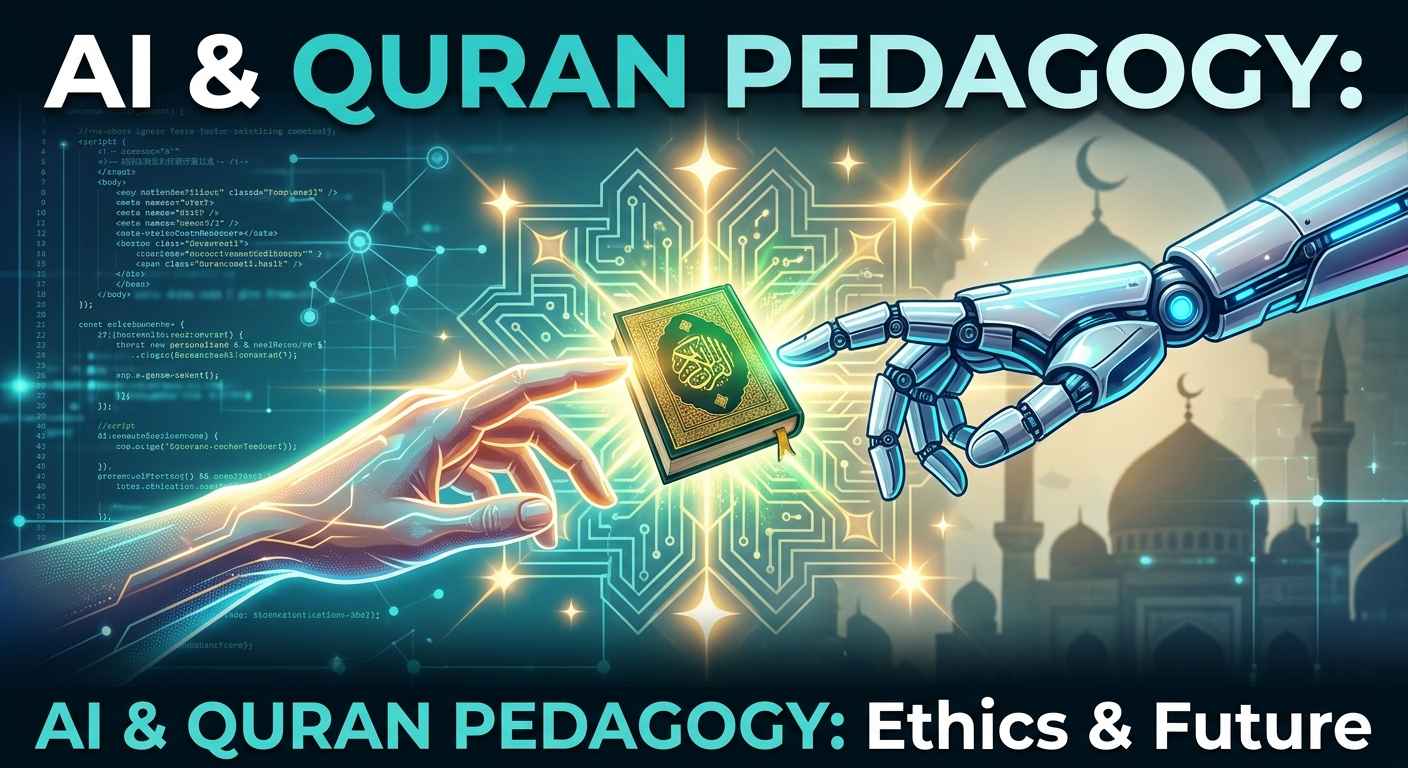
The rapid development of artificial intelligence (AI) is transforming the educational landscape, including the ways religious knowledge is taught, studied, and disseminated. From personalized learning platforms to intelligent tutoring systems, AI offers new opportunities to improve access to information and support learners with diverse educational needs. In the context of Quranic education, these technological developments raise important questions about the relationship between innovation, religious authority, ethical responsibility, and the preservation of authentic understanding.
Quranic pedagogy is not simply concerned with transferring textual information. It encompasses the development of spiritual awareness, moral character, intellectual understanding, and the ability to translate religious teachings into meaningful conduct. Consequently, integrating AI into Quranic education requires more than technical efficiency. It demands careful consideration of the ethical boundaries that should guide the use of technology in religious learning.
Artificial intelligence can support Quranic education, but it should not replace the human, spiritual, and scholarly dimensions that give religious learning its depth and meaning.
AI and the Transformation of Quranic Learning
Traditional Quranic education has historically relied on direct interaction between teachers and students. Through recitation, memorization, explanation, and moral guidance, educators have played an important role in transmitting knowledge and cultivating religious character.
AI introduces additional possibilities into this educational process. Digital tools can help learners practice pronunciation, review memorized verses, explore vocabulary, and access educational resources. They may also provide interactive learning experiences that allow students to study according to their individual pace and needs.
For learners who have limited access to qualified teachers, technology can potentially expand educational opportunities. However, accessibility should not be confused with accuracy. An AI system may produce an explanation that appears convincing while containing errors in translation, interpretation, or contextual understanding.
Quranic education therefore requires a clear distinction between technological assistance and authoritative religious instruction. AI can facilitate learning, but its outputs should be evaluated through reliable sources and qualified educators.
The future of Quranic pedagogy should not be defined by how much technology can automate. It should be evaluated by how effectively technology supports meaningful, accurate, and ethically responsible learning.
The Ethical Boundaries of Artificial Intelligence
The integration of AI into religious education raises several ethical concerns. The first involves the accuracy and reliability of religious information.
The Qur’an has a specific linguistic, historical, and interpretive context. Understanding its teachings requires attention to Arabic language, textual relationships, scholarly traditions, and the diversity of interpretive approaches. An AI system that presents a single explanation without acknowledging relevant context may encourage oversimplification.
The second concern relates to the authority of religious interpretation. AI does not possess religious authority simply because it can generate fluent explanations. Its responses are produced through computational processes and depend on the quality, scope, and limitations of its underlying systems.
Consequently, learners should not automatically regard AI-generated religious answers as equivalent to the guidance of qualified scholars.
The third concern involves the potential for bias. AI systems may reflect limitations in their training materials, language coverage, or design. These limitations can influence how religious traditions and theological differences are represented.
For these reasons, ethical AI-assisted Quranic education should prioritize transparency, verification, contextual awareness, and responsible human oversight.
Preserving the Role of Teachers and Scholars
One of the most important ethical principles in AI-assisted Quranic pedagogy is the preservation of the educator’s role.
Teachers do more than explain religious texts. They observe students’ learning processes, correct misunderstandings, model ethical behavior, and provide guidance that responds to individual circumstances. These responsibilities involve relationships and judgments that cannot be reduced to automated information delivery.
A qualified Quranic educator can help students distinguish between established interpretations, scholarly disagreement, and unsupported claims. Teachers can also encourage students to approach religious knowledge with humility, discipline, and intellectual responsibility.
AI should therefore be positioned as a supporting instrument rather than an independent replacement for religious educators.
A constructive educational model might combine AI-assisted practice with teacher-led instruction, scholarly references, and opportunities for discussion. In this model, technology expands the resources available to learners while educators remain responsible for guiding the learning process.
The objective is not to resist technological development but to ensure that innovation strengthens rather than weakens educational integrity.
Developing Critical Religious Literacy
Religious literacy involves more than the ability to read religious texts or memorize their content. It includes understanding religious concepts, historical contexts, interpretive diversity, and the ways religious teachings influence individuals and societies.
AI can contribute to this development by offering interactive learning activities. Students may use digital tools to compare translations, examine vocabulary, explore historical contexts, and formulate questions for further discussion.
However, these activities must be designed carefully. Comparing translations, for example, does not automatically provide a complete understanding of Quranic interpretation. Students need guidance in recognizing differences between linguistic translation, tafsir, and broader theological analysis.
AI-assisted learning should encourage students to ask questions such as:
- What is the context of this verse?
- Which interpretation is being presented?
- What scholarly sources support this explanation?
- Are there alternative interpretations?
- How can the teaching be understood within its ethical and historical framework?
These questions can help students develop a more reflective relationship with religious knowledge.
The future of religious literacy depends not only on access to information but also on the ability to evaluate, contextualize, and apply that information responsibly.
AI, Personalization, and Educational Equity
One of the potential benefits of AI in Quranic education is personalized learning. Students differ in their levels of reading proficiency, memorization ability, language skills, and learning pace. AI-powered tools may provide exercises that respond to some of these differences.
For example, learners may use digital applications to practice recitation, review previously studied material, or receive feedback on specific learning tasks. Such tools can support independent practice and encourage continuous engagement.
Nevertheless, personalization should not become a substitute for human interaction. Religious learning also involves community, mentorship, shared worship, and the development of ethical relationships.
Educational equity presents another important consideration. Access to AI technologies depends on internet connectivity, digital devices, technical literacy, and economic resources. Institutions that adopt AI-assisted learning should consider whether their implementation may widen existing educational inequalities.
A responsible approach requires investment in teacher training, accessible learning resources, and appropriate technological infrastructure. Innovation should serve learners who face educational barriers rather than benefit only those with the greatest technological access.
Protecting the Integrity of Quranic Text and Recitation
Quranic education has particular requirements concerning textual accuracy and recitation. Errors in Arabic script, pronunciation, transliteration, or verse references can negatively affect the learning process.
AI-assisted tools should therefore be used with appropriate caution. Applications designed for Quranic learning need reliable textual sources, careful quality control, and mechanisms for identifying potential errors.
Recitation feedback can be useful as a supplementary learning aid, but automated evaluation may not capture every aspect of pronunciation, rhythm, or traditional recitation practice. Qualified teachers remain important for providing comprehensive instruction.
The same principle applies to translation and interpretation. Learners should be encouraged to consult recognized Quranic texts and reputable scholarly resources rather than relying on an AI system as their sole reference.
Technological convenience must never take priority over the integrity of religious learning.
Ethical Use of Student Data
The introduction of AI into religious education also raises questions about privacy and data protection.
Digital learning platforms may collect information about students’ learning patterns, performance, questions, and interactions. In religious education, some of these interactions may involve personal beliefs, spiritual concerns, or sensitive questions.
Educational institutions must therefore establish clear policies concerning data collection, storage, access, and use. Students and their families should understand how their information is handled and whether it is shared with third parties.
Children and adolescents require particular protection because they may not fully understand the long-term implications of sharing personal information through digital platforms.
Ethical AI-assisted Quranic pedagogy should place student dignity, privacy, and safety at the center of technological implementation.
The advancement of education should never come at the expense of the rights and well-being of learners.
Integrating Islamic Ethics into AI Education
Islamic ethical principles can contribute to discussions about the responsible use of AI in religious learning. Concepts such as amanah (trust and responsibility), ‘adl (justice), ihsan (excellence in conduct), and maslahah (public benefit) provide opportunities for reflecting on the purposes and consequences of technological innovation.
The principle of amanah encourages institutions and educators to treat technology as a responsibility rather than merely a source of convenience. This includes ensuring the accuracy of learning materials and protecting students’ interests.
The principle of ‘adl invites consideration of fairness and accessibility. AI-assisted education should not create unjust disadvantages for learners who lack access to advanced technologies.
Ihsan emphasizes the pursuit of quality and responsible conduct. In the educational context, this can encourage continuous evaluation of AI systems and the improvement of teaching practices.
Meanwhile, the consideration of maslahah raises a broader question: Does the use of AI genuinely contribute to the educational and ethical development of learners?
These principles do not provide automatic answers to every technological challenge. However, they can offer a valuable ethical framework for evaluating decisions and establishing educational priorities.
Preparing Educators for the AI Era
The effectiveness of AI-assisted Quranic pedagogy depends significantly on the readiness of educators.
Teachers need opportunities to develop digital literacy, understand the limitations of AI systems, and evaluate technology-based learning materials. They should also be equipped to guide students in verifying information and identifying unreliable religious content.
Teacher education programs can incorporate discussions about:
AI literacy: Understanding how AI systems generate and process information.
Religious verification: Evaluating Quranic references, translations, and interpretations.
Ethical responsibility: Protecting student privacy and promoting responsible technology use.
Critical thinking: Encouraging students to question and examine AI-generated information.
Pedagogical integration: Using technology to support rather than replace effective teaching practices.
This preparation is essential because the introduction of AI changes not only the tools available to educators but also the responsibilities associated with religious instruction.
Educators must remain capable of distinguishing between technological functionality and educational value.
Toward a Balanced Model of Quranic Education
The future of Quranic pedagogy should avoid two opposing extremes. The first is technological rejection, which may prevent educators and learners from benefiting from useful innovations. The second is technological dependence, which may undermine scholarly guidance, personal reflection, and the relational dimensions of religious learning.
A balanced model recognizes that AI can support specific educational activities while preserving the central role of human educators and religious scholarship.
In this model, AI may assist with recitation practice, vocabulary exploration, learning assessment, and access to educational resources. Teachers and scholars remain responsible for contextual explanation, ethical guidance, interpretive clarification, and the cultivation of religious character.
Such an approach requires ongoing evaluation. Institutions should examine whether AI tools improve learning outcomes, maintain textual accuracy, support inclusion, and protect student well-being.
Technological innovation should be guided by educational objectives rather than adopted solely because it is new or popular.
Conclusion
AI-assisted Quranic pedagogy presents both opportunities and challenges for the future of religious literacy. Digital technologies can expand access to learning resources, support personalized practice, and encourage new forms of educational engagement. However, these benefits must be balanced with concerns about accuracy, interpretation, privacy, authority, and educational equity.
Artificial intelligence should function as a means of supporting Quranic learning, not as a replacement for qualified teachers, scholarly traditions, or the spiritual dimensions of religious education.
The ethical integration of AI requires a commitment to accuracy, responsibility, critical thinking, and human dignity. Islamic values such as amanah, ‘adl, and ihsan can contribute to this process by encouraging educators and institutions to evaluate technology according to its educational and ethical consequences.
Ultimately, the future of Quranic education will not be determined by technology alone. It will depend on how educators, scholars, institutions, and communities choose to use technological innovation in service of knowledge, character, and human development.
By establishing clear ethical boundaries and maintaining the centrality of human guidance, AI-assisted Quranic pedagogy can contribute to a future in which religious literacy is more accessible, reflective, and responsibly developed.
#Dr. Bambang Wahrudin, M.Pd.