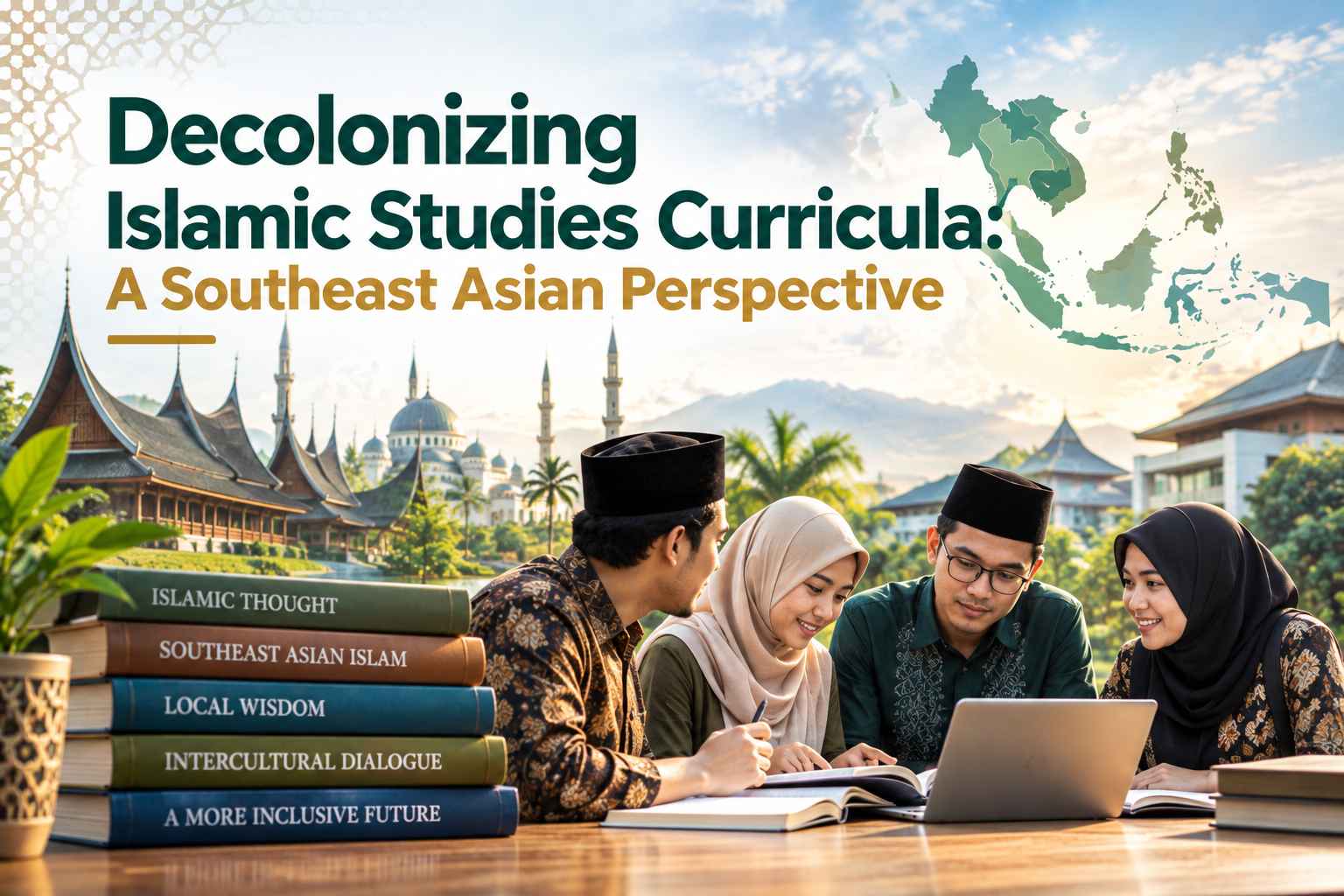
Islamic studies in higher education plays an important role in developing religious understanding, intellectual awareness, and social responsibility. However, in an increasingly interconnected world, questions about curriculum, knowledge production, and academic representation have become increasingly significant. From a Southeast Asian perspective, decolonizing Islamic studies offers an opportunity to reconsider how Islamic knowledge is taught, whose intellectual contributions are recognized, and how education responds to local realities.
Decolonization does not mean rejecting Western scholarship or abandoning established academic traditions. Rather, it involves critically examining inherited frameworks and creating space for diverse intellectual perspectives. Southeast Asia, with its rich Islamic history and cultural diversity, provides valuable resources for this conversation.
Islamic educational traditions in Indonesia, Malaysia, Brunei, and other parts of the region have developed through complex interactions between religious scholarship, local cultures, colonial experiences, and modern educational institutions. These histories demonstrate that Islamic knowledge has never developed through a single intellectual pathway.
A decolonized curriculum should therefore introduce students to the contributions of Southeast Asian scholars, pesantren traditions, Islamic organizations, and local intellectual movements. It should also explore how Islamic teachings have been interpreted in response to social challenges, including education, democracy, gender relations, environmental responsibility, and community development.
Such an approach can strengthen students’ critical thinking while encouraging them to appreciate the diversity of Islamic intellectual traditions. It also helps prevent the assumption that authoritative Islamic knowledge must always originate from outside Southeast Asia.
Nevertheless, decolonizing Islamic studies requires academic rigor. Local perspectives should not be accepted uncritically, just as Western theories should not be dismissed automatically. Comparative scholarship, historical analysis, and engagement with diverse sources remain essential to producing credible knowledge.
Universities can support this transformation by developing interdisciplinary curricula, strengthening regional research, translating important scholarly works, and encouraging dialogue between traditional Islamic institutions and contemporary academic communities.
Ultimately, decolonizing Islamic studies is not simply a matter of changing reading lists. It is a broader effort to create educational environments that recognize intellectual diversity, historical complexity, and the relevance of local experiences.
By integrating Southeast Asian perspectives with global academic dialogue, Islamic studies can become more inclusive, critically engaged, and responsive to the realities of contemporary Muslim societies.
#Dr. Katni, M.Pd.I.