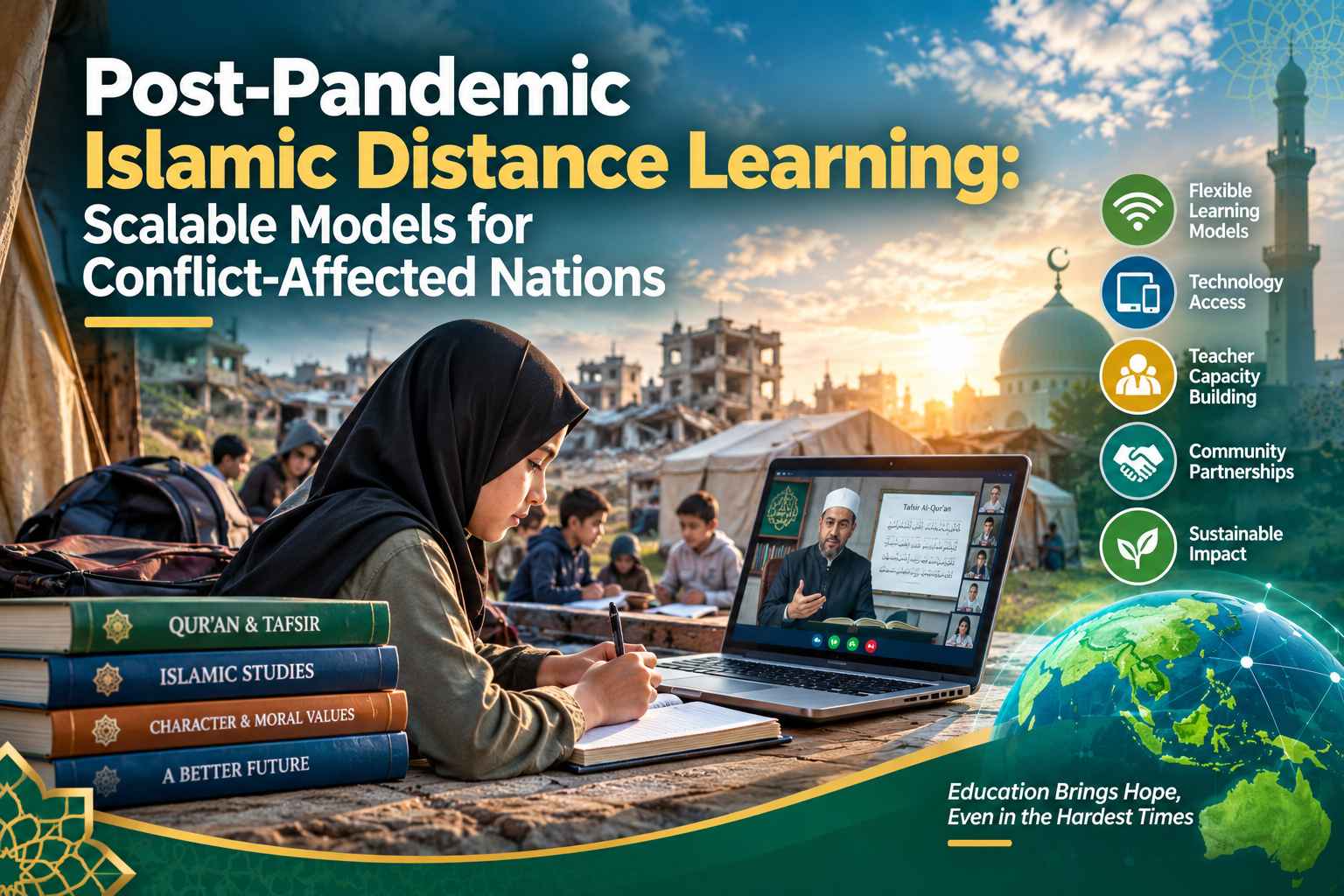
The COVID-19 pandemic transformed education systems worldwide, exposing significant inequalities in access to technology, infrastructure, and qualified teachers. For conflict-affected nations, these challenges are even more complex. Armed conflict, displacement, damaged schools, and economic instability continue to prevent millions of children and young people from accessing quality education. In this context, Islamic distance learning offers opportunities to develop flexible, accessible, and sustainable educational models.
Islamic education plays an important role in developing knowledge, ethical awareness, and spiritual character. Through digital platforms, online learning materials, and community-based education, Islamic institutions can extend their educational services to learners who face geographical and security barriers. However, successful implementation requires more than simply transferring traditional lessons into digital formats.
One scalable approach involves combining online learning with offline educational resources. In regions where internet connectivity is limited, students can access recorded lessons, downloadable materials, radio-based instruction, and mobile learning applications. This blended model allows educational institutions to adapt their programs to local technological conditions while maintaining continuity during emergencies.
Another important strategy is strengthening teacher capacity. Educators need training in digital pedagogy, curriculum adaptation, and inclusive learning practices. Islamic scholars and teachers can collaborate with technology specialists to develop educational content that is academically reliable, culturally relevant, and appropriate for different age groups.
Nevertheless, distance learning in conflict-affected communities faces substantial challenges. Limited electricity, inadequate devices, language barriers, and psychological distress can reduce students’ participation. Educational programs must therefore incorporate flexible schedules, psychosocial support, and community partnerships. Religious education should also remain sensitive to diverse interpretations and avoid presenting technology as a substitute for qualified teachers.
Islamic educational institutions can contribute by partnering with humanitarian organizations, governments, universities, and local communities. Such cooperation may support teacher training, infrastructure development, educational resource distribution, and monitoring of learning outcomes.
The future of Islamic distance learning depends on its ability to combine technological innovation with educational equity, ethical responsibility, and local community needs.
Ultimately, post-pandemic education should not merely restore previous systems but develop more resilient and inclusive approaches. By integrating digital tools with community-based support and Islamic educational values, institutions can help ensure that conflict-affected learners continue to access knowledge, develop essential skills, and maintain hope for a more peaceful future.
#Devid Dwi Erwahyudin, M.Pd.