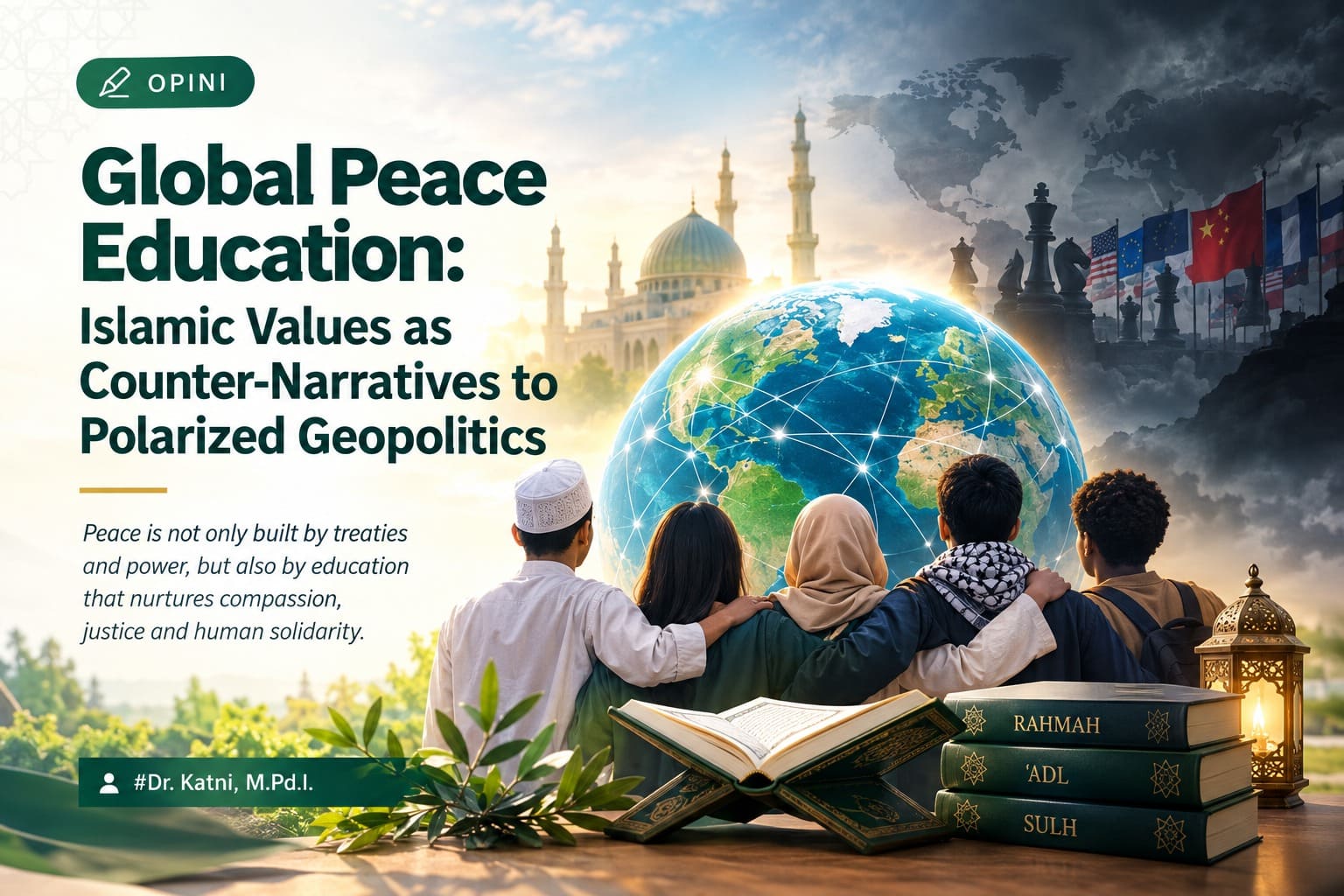
The contemporary international order is buckling under the weight of ideological fracturing and zero-sum geopolitics. From Eastern Europe to the Middle East and the Indo-Pacific, major power rivalries have increasingly reduced diplomacy to security alliances and economic containment. Yet, while realpolitik may manage immediate crises, it remains fundamentally incapable of addressing the systemic distrust and dehumanization driving global instability. To break this cycle of escalation, the international community must rethink how peace is cultivated not just through treaties and deterrence, but through education grounded in universal ethical frameworks.
In this effort, Islamic ethical traditions offer a potent, underutilized counter-narrative to the logic of global division.
For decades, mainstream geopolitical discourse has frequently reduced Islam to a vector of conflict or geopolitical friction. This narrative not only ignores centuries of intellectual history but also overlooks the core tenets of Islamic jurisprudence and philosophy that prioritize systemic harmony. At a time when global politics is increasingly framed through binary “us versus them” dynamics, Islamic humanism provides vital tools for dismantling geopolitical polarization.
Central to this ethos is the Qur’anic principle of lita’arafu the imperative that human diversity in nationhood, language, and culture exists intentionally to foster mutual recognition rather than domination or conflict. Far from promoting insular tribalism, this framework establishes pluralism as a fundamental law of human existence. When translated into global peace education, lita’arafu challenges the tribalism that fuels contemporary nationalism and civilizational conflict.
Furthermore, Islamic peacebuilding relies on a holistic triad of values: rahmah (universal compassion), ‘adl (restorative justice), and sulh (active reconciliation). Unlike modern realpolitik, which often defines peace as merely the temporary absence of armed conflict, these principles assert that stable peace is impossible without equity. A peace built solely on power balances is inherently fragile; true stability requires addressing structural injustices and restoring human dignity to all sides of a dispute.
Integrating these perspectives into global educational systems serves two critical purposes. First, it equips the next generation of diplomats, policymakers, and global citizens with a nuanced moral vocabulary that transcends Western-centric models of conflict resolution. Second, it reclaims Islamic values from both radical extremists who distort them and foreign policy analysts who dismiss them.
As the international system faces deep structural fractures, relying on traditional security apparatuses to maintain order is a recipe for perpetual conflict. Rebuilding global stability requires investing in peace education that leverages the world’s rich moral traditions. By embracing Islamic values of pluralism, compassion, and justice as universal educational tools, we can begin to dismantle the rhetoric of polarization and build a sustainable architecture for peace.
#Dr. Katni, M.Pd.I.